
Pet-Friendly Cleaning · Montreal · Laval · Longueuil · Practical Guide
Pet-Friendly House Cleaning — What Actually Makes a Cleaning Service Safe for Your Animals
Every cleaning company in Montreal says its services are pet-friendly. Almost none explain what that claim actually means — which specific products are dangerous for cats, which are dangerous for birds but not for dogs, why the sealed-window Montreal winter makes product choices matter more than in summer, or how a professional clean in a home with animals differs from a standard visit in its sequence and priorities. This guide fills that gap.
If you’re a pet owner in Montreal, you know that maintaining a clean home while keeping your pets safe can be challenging. From shedding fur to paw prints and unexpected messes, homes with pets require extra care and attention.
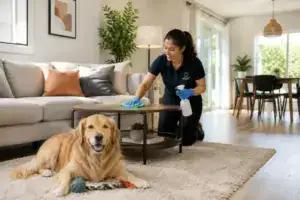
Our pet-friendly cleaning services in Montreal are designed to provide a deep, professional clean with eco-friendly, non-toxic products that are safe for dogs, cats, and other household pets. We believe your pets are family — and their safety always comes first.
Quick Answer
Question: Are professional cleaning services safe for pets in Montreal, and what should I look for?
Yes — when the provider uses products selected for the species present. Key facts: cats are sensitive to phenol-based cleaners and benzalkonium chloride (common in disinfectant wipes); birds are sensitive to any aerosol VOC and should always be moved to a ventilated area during cleaning; dogs are the most tolerant but react to concentrated bleach fumes. The Montreal Cleaners uses eco-certified, low-VOC products and HEPA vacuuming on all residential visits — including pet-hair removal from upholstery and dander-focused priority on HVAC vents and bedding zones. Available across Montreal, Laval, Longueuil, and the South Shore. Weekly service recommended for homes with shedding pets.
Why the Montreal Winter Makes Pet Cleaning More Important — and More Complicated
A home with two cats in Montreal operates under fundamentally different indoor air quality conditions in February than in July. In July, windows are open, fresh air dilutes indoor pollutants continuously, and the pet dander, mould spores, and dust mite populations that the cats contribute are regularly flushed from the indoor air column. In February, the home is sealed — and has been sealed since late October.
Over six months of sealed-window heating season, every indoor pollutant concentrates. Pet dander — the primary allergen from cats and dogs, not the hair — accumulates in HVAC vents, mattresses, upholstery, and carpet pile. The forced-air heating system cycles continuously, redistributing that dander through every room with each activation. By March, a Montreal home with two cats that hasn’t been professionally cleaned since October has an indoor allergen load that is measurably higher than the same home would have in the same climate with windows open.
“Pet dander is not pet hair. Hair is visible — you can see it on the sofa and remove it. Dander is microscopic flakes of shed skin, 2–10 micrometres in diameter, light enough to remain airborne for hours. It concentrates on any surface the air touches — mattress surface, HVAC grille, window sill, book spines. In a sealed Montreal home in January, with a forced-air system running 6–8 hours a day, dander distributes to every room continuously. Vacuuming without HEPA filtration recirculates it.”
— Environmental allergen research summary
This matters for cleaning strategy, not just for allergy sufferers. A cleaning approach that addresses pet hair visually — removing what’s on the sofa, vacuuming what’s on the floor — and doesn’t address the dander accumulation in HVAC vents, mattress surfaces, and upholstery seams is addressing the symptom rather than the source. The home looks cleaner after the visit but the allergen load hasn’t changed significantly.
What’s Actually Toxic — By Species
“Pet-friendly products” as a category doesn’t mean much without knowing which pet and which products. The toxicology profiles of common household cleaning chemicals differ significantly across species — and “safe for dogs” does not mean “safe for cats,” let alone “safe for birds.” Here is the practical breakdown that most cleaning companies don’t provide.
🐱 Cats — the most chemically sensitive common household pet
Cats are obligate carnivores with a significantly reduced ability to metabolize certain compounds compared to dogs or humans. Two categories of common cleaning chemicals are particularly hazardous:
✓ Safe categories for cat households: pH-neutral plant-based surfactants without essential oil concentrates, hydrogen peroxide-based disinfectants (at dilute concentrations, well-rinsed), and enzyme-based odour eliminators.
🐶 Dogs — more tolerant, but not immune
Dogs are significantly more metabolically tolerant of common cleaning chemicals than cats — but this tolerance is often overstated. The relevant risks for dogs in a cleaned household are:
✓ Key protocol for dog households: ensure all floor surfaces are thoroughly rinsed after disinfectant application, and allow 20–30 minutes for surfaces to dry fully before the dog accesses the cleaned zone.
🦜 Birds — the most sensitive, requiring the most precaution
Birds have a unique respiratory system — a continuous-flow system rather than the mammalian tidal-flow system — that is exceptionally efficient at extracting oxygen from air and equally efficient at absorbing airborne toxins. This makes birds acutely sensitive to indoor air quality in ways that have no mammalian equivalent.
✓ Protocol for bird households: birds must always be moved to a separate, well-ventilated area (preferably outdoors or in a room with a window open) for the duration of the cleaning visit and for at least 1–2 hours afterward. Pump spray bottles (not aerosols), low-VOC eco-certified products, and thorough ventilation are the minimum standard.
🐰 Rabbits, guinea pigs, hamsters, and small animals
Small mammals have respiratory sensitivity intermediate between dogs and birds. They spend most of their time close to the floor — where cleaning product residues concentrate — and they groom themselves, meaning surface residues transfer to their digestive systems. The most important precautions for small animal households are: ensure cage and habitat areas are cleaned only with water and species-safe products, not with general disinfectants; avoid any aerosol products in the room where the habitat is located; and ensure adequate ventilation after cleaning before the animal returns to the cleaned space.
✓ Key: ask your cleaning company specifically what products they use near small animal habitats — this is different from what they use elsewhere in the home, and should be confirmed before the first visit.
How a Professional Clean Differs in a Pet Household — Sequence and Priorities
A home with animals requires a different cleaning sequence than a standard household — not different products alone, but a different order of operations that reflects how pet dander and hair actually distribute through the space.
| Task | Standard home sequence | Pet household sequence |
|---|---|---|
| HVAC vents | During or after surface cleaning | First — before any other task, so dander released by disturbance settles before floors are mopped |
| Upholstery and furniture | After floors | Before floors — dislodged hair and dander settle to floor, which is then vacuumed in the final pass |
| Mattress | Bed made after surfaces dusted | HEPA vacuumed before bedding replaced — pets on the bed means mattress is a primary dander accumulation zone |
| Floor vacuuming | Single pass, surface pick-up | Multi-directional HEPA pass — pet hair embeds against pile direction; cross-direction pass releases it |
| Pet feeding and water areas | N/A | Cleaned with water-only or species-safe product — never disinfectant. Area around food bowls mopped only after bowls removed |
| Odour treatment | Air freshener or scented product as needed | Enzyme-based treatment on identified odour sources (urine salt deposits, sebaceous spots on upholstery) — no aerosol air fresheners, especially in bird households |
Pet Hair vs. Pet Dander — Why the Visible Problem Isn’t the Real Problem
Pet hair is visible. It accumulates on the sofa, on the floor, on clothing. It’s annoying and it signals a cleaning need. But it is not what causes allergic reactions to pets — and it is not what a cleaning visit should primarily target if health is the goal.
Pet dander — microscopic flakes of shed skin, 2 to 10 micrometres in diameter — is the primary carrier of the proteins (Fel d 1 in cats, Can f 1 in dogs) that trigger allergic responses. Dander is so light it remains airborne for hours after disturbance, and it accumulates on any surface that air contacts — not just horizontal surfaces like floors and furniture, but vertical surfaces, HVAC grilles, window sills, and even walls. A home that looks free of pet hair after a cleaning visit may still have a high dander load in all of these zones.
The dander accumulation zones in a Montreal pet household
High accumulation — professional priority
- HVAC supply and return vents
- Mattress surface and sides
- Upholstery seams and cushion undersides
- Carpet pile base layer
- Under furniture (primary settling zone)
- Bedroom ceiling fan blades
Lower accumulation — standard cleaning
- Hard floor surfaces
- Window sills
- Kitchen counters
- Bathroom surfaces
- Vertical wall surfaces
- Clothing (managed by homeowner)
Pet Odour in a Montreal Home — Source Treatment vs. Masking
Pet odour in a sealed Montreal home in winter is one of the more persistent cleaning challenges — and one where the distinction between source treatment and odour masking matters most.
Pet urine, even when dried and apparently gone, leaves behind uric acid salt crystals that are odourless in dry conditions but reactivate in humidity — releasing mercaptans and ammonia compounds that produce the characteristic smell. In a Montreal home with humidity fluctuations through the winter heating season, these crystals activate and deactivate on a cycle that makes the odour seem to come and go independently of cleaning.
Scented cleaning products, air fresheners, and deodorizing sprays mask the odour by adding a competing scent that temporarily overwhelms the olfactory perception of the urine compounds. They do not address the uric acid crystals. The odour returns when the masking scent dissipates — typically within hours.
The professional approach to pet odour is enzyme-based treatment: biological enzyme cleaners contain bacterial cultures that metabolize uric acid crystals, permanently breaking down the odour source rather than masking it. Enzyme treatment requires identifying the specific location of urine deposits (a UV light reveals dried urine stains not visible in normal light), applying the enzyme product and allowing adequate reaction time (typically 15–30 minutes), and then cleaning the treated area. One enzyme treatment done correctly eliminates the odour source permanently; repeated masking treatments do not.
How Often to Clean — Montreal Pet Households by Profile
Single pet, no shedding, no allergy sufferers → Bi-weekly
A single short-haired cat or low-shedding dog in a household without allergy sufferers can be managed with bi-weekly professional cleaning. Supplement with daily brushing of the pet (which removes loose hair and dander before it distributes) and weekly vacuuming of the pet’s primary sleeping surface.
Multiple pets or one shedding pet → Weekly
Two cats, a dog, or a single heavy-shedding breed in a Montreal home requires weekly professional cleaning during the winter months to manage dander and hair accumulation at a liveable baseline. This is the minimum for the November–April sealed-window period; bi-weekly may be sufficient May–October.
Pets + allergy sufferers in the household → Weekly + seasonal deep clean
When someone in the household has a documented allergy to pet dander, weekly cleaning is the baseline, combined with seasonal deep cleans in May and October that address mattresses, HVAC vents, upholstery seams, and all high dander accumulation zones. HEPA-filtered air purifiers in bedrooms significantly supplement the cleaning strategy.
Bird households → Weekly, with specific protocol
Birds produce their own dander (fine feather powder, particularly from cockatoos, cockatiels, and African grey parrots) and are simultaneously the most sensitive species to cleaning product exposure. Weekly cleaning with confirmed low-VOC, pump-spray products, with the bird moved to a ventilated area for the duration of the visit and for 2 hours afterward.
Cleaning Rates for Pet Households — Montreal, Laval and Longueuil
Pet household cleaning typically runs 10–20% more than equivalent-sized homes without animals, reflecting additional HEPA vacuuming passes, upholstery attention, and extended time for the priority zones described above.
| Home Size | Weekly (no pets) | Weekly (1–2 pets) | Bi-Weekly (1–2 pets) |
|---|---|---|---|
| Studio / 1-bedroom | $90–$130 | $100–$150 | $115–$172 |
| 2-bedroom apartment / condo | $120–$180 | $135–$205 | $155–$236 |
| 3-bedroom home | $155–$260 | $175–$295 | $200–$340 |
| Enzyme odour treatment (add-on) | N/A | $40–$80 per zone (quoted on site) | |
*2026 rates before taxes (GST + QST ≈ 14.975%). Pet household rates reflect additional time for HEPA passes, upholstery attention, and dander-priority sequencing. Final pricing depends on number of animals, their shedding profile, and home condition. Always confirm with a flat-rate written quote.
Why Choose Pet-Friendly Cleaning Services in Montreal?
Not all cleaning products are safe for animals. Many traditional products contain harsh chemicals that can irritate your pet’s skin, paws, or respiratory system. Our safe cleaning services for pets in Montreal focus on:
- Non-toxic and biodegradable cleaning solutions
- Low-VOC products to protect indoor air quality
- Safe floor cleaning with no harmful residues
- Careful cleaning around pet beds, toys, and feeding areas
- Your home gets professionally cleaned — without compromising your pet’s health.
Pet-Safe Professional Cleaning in Montreal, Laval and Longueuil
The Montreal Cleaners uses eco-certified, low-VOC products with confirmed safety profiles for cats, dogs, and birds. Our pet household cleaning protocol prioritizes HVAC vents, upholstery, and mattress surfaces before floors — addressing dander at the source zones rather than just the visible hair on the surface. Tell us your species when booking and we’ll confirm the appropriate products before arrival.
- Eco-certified, low-VOC products — confirmed safe for cats, dogs, birds
- HEPA vacuuming standard — dander, not just hair
- Pet-household priority sequence — vents and upholstery first
- Enzyme odour treatment available for urine salt deposits
- No aerosol sprays in bird households — confirmed before arrival
- Weekly and bi-weekly recurring service across Greater Montreal
📞 1-833-800-3330 · Montreal · Laval · Longueuil · South Shore · 7 days a week
Frequently Asked Questions
Are Your Cleaning Products Safe for Dogs and Cats?
Yes. We use eco-friendly cleaning products that are:
- Free from unnecessary harsh chemicals
- Safe for hardwood, tile, laminate, and carpet
- Gentle on paws and pet-sensitive surfaces
Because pets spend most of their time on the floor, we ensure surfaces are thoroughly cleaned and properly rinsed to avoid residue buildup.
How We Protect Your Pets During Cleaning Visits
We take extra precautions to ensure your pets feel safe and comfortable during every visit.
Respect for Pet Spaces
We carefully clean around:
- Pet beds and crates
- Food and water bowls
- Litter box areas
- Favorite resting spots
Secure Entry & Exit
Doors are always handled carefully to prevent accidental escapes.
Calm & Professional Approach
Our team works efficiently and calmly to minimize stress for anxious pets.
Custom Instructions Welcome
Every pet is different. Let us know about any special instructions, and we’ll accommodate them.
Benefits of Professional Cleaning for Pet Owners
Homes with pets require more frequent maintenance. Our apartment cleaning services in Montreal and house cleaning services help you:
- Remove pet hair from furniture and carpets
- Eliminate pet-related odours
- Reduce allergens and dander
- Sanitize high-touch surfaces safely
- Maintain healthier indoor air quality
Regular cleaning keeps your home fresh and hygienic for both pets and people.
Do Pets Need to Be Removed During Cleaning?
In most cases, pets can safely remain at home during the cleaning appointment. However, if your pet is anxious or territorial, you may choose to keep them in a secure room for added comfort.
We are flexible and work according to your preferences.
Deep Cleaning for Homes with Pets in Montreal
For homes with heavy shedding or multiple pets, we recommend periodic deep cleaning services that include:
- Detailed vacuuming with high-efficiency filters
- Deep floor sanitation
- Upholstery and furniture cleaning
- Thorough dust removal from baseboards and surfaces
This ensures a healthier living environment year-round.
Serving Pet Owners Across Montreal
Whether you live in an apartment, condo, or house, our pet-safe cleaning services in Montreal are designed to fit your lifestyle. We offer:
- One-time cleaning
- Recurring weekly, biweekly, or monthly cleaning
- Move-in / Move-out cleaning
- Deep cleaning services
Your home deserves professional care — and so do your pets.
Safe Cleaning for Every Member of Your Family
A truly clean home should be safe for everyone — including your pets. With our pet-friendly cleaning services in Montreal, you get professional results using eco-conscious products and responsible cleaning practices.
Enjoy a spotless home without worrying about your pet’s safety.
Related Services
| → Eco-Friendly Green Cleaning Services | → Deep Cleaning Services Montreal |
| → Regular Recurring Cleaning | → Spring & Fall Cleaning Montreal |
| → Hygienic vs Visual Cleaning | → Book a Pet-Safe Clean |
Originally published May 2018 · Fully rewritten August 2026 · The Montreal Cleaners — All rights reserved