

🤖 Direct Answer
Professional mold cleaning in Montreal involves three steps: (1) identification of the mold species and affected area, (2) containment of spores during removal to prevent spread, (3) application of EPA/Health Canada–approved antifungal agents with minimum contact time, followed by HEPA vacuuming and surface treatment to prevent regrowth. DIY cleaning with bleach only masks surface mold — it does not kill root hyphae embedded in porous materials like drywall or grout. The Montreal Cleaners provides certified mold cleaning across Greater Montreal — free assessment, eco-certified products, satisfaction guarantee.
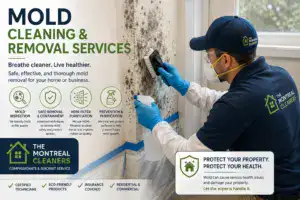
Mold is one of the most misunderstood problems in Montreal homes. The black or green patch you see on the grout, the bathroom ceiling or behind furniture is the visible part of a biological organism whose root system — the mycelium — can penetrate several millimetres into porous surfaces like drywall, grout, wood and fabric. Wiping the surface with bleach removes the visible patch. It does not address the root system. In two to four weeks, the visible growth returns, often larger.
According to Health Canada, mold exposure is linked to respiratory symptoms, allergic reactions, eye and skin irritation, and in sensitive individuals (children, elderly, immunocompromised), more serious health effects. In Quebec’s climate — where windows stay closed for five or more months — indoor mold risk is significantly higher than in milder Canadian cities. Professional treatment is not a luxury. For anyone with respiratory conditions or children in the home, it is a health necessity.
Why Montreal homes develop mold faster than most Canadian cities
❄️ Long sealed winters (Nov–Apr)
Windows closed for 5+ months mean moisture from cooking, showering and breathing has nowhere to go. It condenses on cold surfaces — walls, windows, corners — and creates the moisture mold needs to grow.
🏢 Dense housing stock
Montreal’s triplexes, duplexes and older apartment buildings have less insulation than newer construction. Cold exterior walls create condensation zones — exactly where mold establishes itself.
💧 Spring temperature swings
March and April in Montreal bring rapid temperature changes — warm air outdoors meets cold interior walls. This produces condensation inside walls and in corners, often going unnoticed until mold is visible.
🚿 Inadequate ventilation in older units
Many pre-1980 buildings on the Plateau, in NDG and in Rosemont have bathroom exhaust fans that vent into wall cavities rather than outside — a code violation common in older Montreal housing stock that guarantees chronic moisture problems.
Mold types common in Montreal homes — and their risks
| Mold Type | Appearance | Common locations | Health risk |
|---|---|---|---|
| Cladosporium | Olive-green to brown/black | Bathroom grout, window sills, HVAC vents | Moderate — respiratory irritation |
| Penicillium | Blue-green, powdery texture | Water-damaged drywall, insulation, carpet | Moderate — mycotoxin producer |
| Aspergillus | Green, grey or brown colonies | Air ducts, insulation, food storage | High — serious risk for immunocompromised |
| Stachybotrys (“black mold”) | Slimy black patches | Water-damaged drywall, behind walls, basements | High — requires professional remediation |
⚠️ When to stop DIY and call a professional immediately
If the affected area is larger than 1 square metre, if the mold is black and slimy (potential Stachybotrys), if anyone in the household has respiratory symptoms, or if the mold is inside walls or under flooring — do not attempt DIY remediation. Disturbing mold without containment spreads spores throughout the entire space and significantly worsens the problem.
Our professional mold cleaning protocol — step by step
Assessment and containment
We identify the extent of contamination and the likely moisture source. Plastic sheeting is used to isolate the treatment area and prevent cross-contamination of adjacent rooms. Ventilation is assessed to ensure spores are not recirculated through HVAC.
HEPA vacuuming of loose spores
Before applying any liquid treatment, loose mold spores on the surface and surrounding areas are captured with a HEPA-filtered vacuum. This prevents wet treatment from spreading airborne spores.
Antifungal treatment with contact time
Our eco-certified antifungal agents are applied to the affected surface and left for a minimum of 10–15 minutes. This contact time is essential for the chemistry to penetrate and kill the root system (mycelium), not just the surface colony. Bleach-based products do not have this penetration ability on porous surfaces.
Mechanical removal and surface treatment
Visible mold colonies are removed with dedicated brushes and disposable cloths. For grout and silicone joints, we use a grout brush with the antifungal agent applied for a second pass. Surfaces are wiped dry to remove all residue.
Prevention treatment and moisture guidance
A mold-inhibiting sealant is applied to treated surfaces where appropriate. We also identify and advise on the moisture source — because without addressing the cause (inadequate ventilation, condensation, plumbing leak), mold will return regardless of how thorough the cleaning was.
DIY mold cleaning vs professional remediation — the honest comparison
| Factor | DIY (bleach + scrubbing) | The Montreal Cleaners |
|---|---|---|
| Root system | Not addressed — bleach doesn’t penetrate porous materials | Treated with penetrating antifungal agent |
| Spore containment | None — scrubbing releases spores into the air | HEPA vacuuming + containment protocol |
| Recurrence | 2–4 weeks for visible regrowth | Prevented if moisture source addressed |
| Air quality during treatment | Significant exposure risk | VOC-free products, controlled environment |
| Suitable for | Very early-stage surface mold only (< 30 cm²) | All stages, all surfaces, all mold types |
Mold you can see is only the beginning. Let us handle the rest.
Free assessment of affected areas. Eco-certified antifungal products. Satisfaction guarantee. Serving all of Greater Montreal.
Mold by room — where it hides in Montreal homes
« Our NDG duplex had a persistent mold problem in the second-floor bathroom for three years. Every cleaner we tried would scrub it with bleach and it would come back in a month. TMC identified that our exhaust fan was venting into the wall cavity — not outside. They treated the mold properly AND explained the root cause. No recurrence in 14 months. »
— Daniel & Priya K., Notre-Dame-de-Grâce, Montreal ⭐⭐⭐⭐⭐
💬 Questions people ask about mold cleaning
❓ “Does bleach kill mold permanently?”
No. Bleach kills surface mold colonies on non-porous surfaces (glass, chrome) but cannot penetrate porous materials (grout, drywall, wood) to reach the mycelium root system. On these surfaces, bleach removes the visible black color while the root system survives and regrows within weeks.
❓ “Is mold in my Montreal apartment my landlord’s responsibility?”
Under Quebec’s Civil Code and Régie du logement guidelines, landlords are responsible for maintaining habitable conditions — which includes addressing mold caused by structural issues (roof leaks, inadequate insulation, defective ventilation). Mold caused by a tenant’s failure to ventilate may be shared responsibility. Document the mold with photos and notify your landlord in writing first.
❓ “How quickly can mold spread in a Montreal apartment?”
Mold can begin growing within 24–48 hours of a moisture event (leak, flooding, prolonged condensation). A small colony of 10 cm² can double in size within a week under ideal conditions (moisture + organic material + temperature above 4°C). Quebec’s warm indoor environments in winter provide exactly the right conditions for rapid growth.
Frequently Asked Questions — Mold Cleaning Montreal
Professional mold cleaning in Montreal — done right, the first time.
Montreal · Laval · Longueuil · NDG · Westmount · Plateau · West Island · 🌿 VOC-free · 🛡️ Insured