
Commercial Cleaning Technicians · Montreal · Laval · Longueuil · 2026
Office and Commercial Cleaning Technicians in Montreal — What Separates a Trained Professional from a General Cleaner
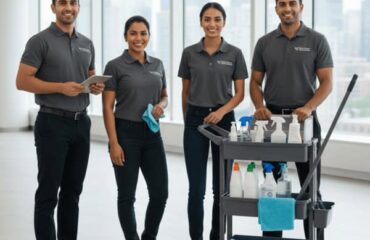
Most cleaning companies describe their staff as “experienced” and “professional.” Almost none explain what that actually means in practice — what training a cleaning technician has received, what background checks were performed before they were given access to your office, what safety obligations the company meets under Quebec law, and what a trained technician does differently than someone handed a mop for the first time. This article answers all of those questions directly.
The Core Difference — Systematic Protocol vs. Intuitive Cleaning
The most important distinction between a trained commercial cleaning technician and an untrained general cleaner is not effort or diligence — it’s systematization. Both may work equally hard. What differs is whether the result is consistent, predictable, and documented.
An untrained cleaner cleans what looks dirty, using whatever products are available, in whatever order seems logical to them. The result depends entirely on their individual judgment — which means it varies from visit to visit, from person to person, and degrades whenever the regular cleaner is replaced by a substitute.
A trained commercial cleaning technician follows a defined protocol that produces the same result regardless of who applies it, on which visit, in which office. That protocol covers four dimensions:
1. Sequence — top to bottom, dry before wet
Dust falls. If you mop the floor before dusting the shelves, you’re cleaning the floor twice. A trained technician always begins at the highest point in the room — ceiling vents, top shelves, light fixtures — and works downward, so that anything dislodged lands on surfaces that haven’t been cleaned yet. Within that sequence, dry tasks (dusting, vacuuming) always precede wet tasks (mopping, disinfecting surfaces), so that wet products aren’t applied to dusty surfaces where they bind particulate into a harder-to-remove layer.
2. Zone separation — color-coded to prevent cross-contamination
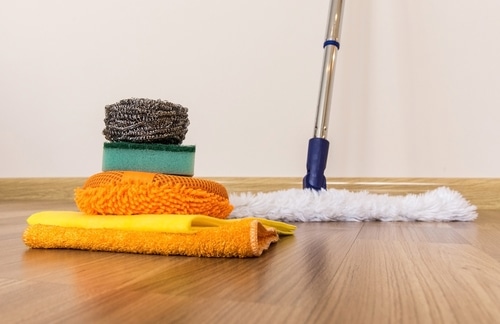
A cloth used to wipe the washroom toilet should never touch the kitchen counter. This seems obvious — but without a systematic color-coding system, cross-contamination occurs in ways that are invisible but microbiologically significant. Professional commercial cleaning operations use color-coded microfibre cloths and mop heads: typically red for washrooms, yellow for kitchens and food preparation areas, blue for general office surfaces, and green for glass. The system removes the judgment call — the right color goes to the right zone, every time.
3. Product-surface matching — the chemistry that matters
Every surface has a chemistry — and every cleaning product has a chemistry. When they conflict, the product damages the surface invisibly at first, and visibly over months. An all-purpose spray cleaner (typically mildly acidic) applied to a polished concrete floor or a marble countertop causes microscopic etching that dulls the finish permanently. Bleach on stainless steel causes pitting. Abrasive cloths on quartz produce micro-scratches that trap soil. A trained technician identifies surfaces before selecting products and never defaults to an all-purpose solution on a specialized surface.
4. Dwell time — the step that most untrained cleaners skip
Disinfectants don’t work instantaneously. Every hospital-grade disinfectant product has a documented contact time — the minimum period the product must remain wet on the surface to achieve the claimed kill rate against its target organisms. For most commercial disinfectants, this is 30 seconds to 10 minutes depending on the organism. A technician who sprays and immediately wipes has cleaned the surface but has not disinfected it — regardless of what the label says. Trained technicians apply disinfectant, move to another task, and return to wipe after the required contact time has elapsed.
What Training a Commercial Cleaning Technician in Montreal Actually Receives
There is no provincial certification requirement for general commercial cleaning technicians in Quebec — the industry is self-regulated at the company level. This means the quality and depth of training varies enormously between companies, and the “experienced professionals” claim on a company website may reflect anything from a rigorous onboarding program to a half-day orientation.
A serious commercial cleaning company in Montreal trains its technicians on at minimum the following before they enter a client site unsupervised:
WHMIS — Workplace Hazardous Materials Information System
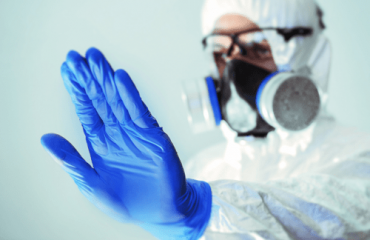
In Quebec, employers must provide workplace-specific WHMIS education and training to workers who are exposed or likely to be exposed to hazardous products. WHMIS training covers how to read Safety Data Sheets (SDS), how to identify hazard pictograms on product labels, proper storage and handling procedures, and emergency response if a product is misused or a spill occurs. The training should be specific to the products and hazards the worker may encounter at the assigned site.
Surface and product training — what goes on what
A structured surface-product compatibility matrix covers the common surfaces in commercial environments (hardwood, polished concrete, quartz, marble, ceramic tile, stainless steel, glass, upholstery, carpet) and the correct product categories for each (pH-neutral for stone and wood, non-abrasive for quartz, hospital-grade disinfectant for medical zones, solvent-based for adhesive residue). The training also covers dangerous combinations — bleach and ammonia produce toxic chloramine gas, an error that occurs in unregulated environments more frequently than most clients realize.
Ergonomics and MSI prevention
Commercial cleaning is physically demanding work — repetitive mopping, vacuuming, bending, and lifting. Musculoskeletal injuries (MSIs) are among the most frequent workplace injuries in the cleaning sector. A trained technician learns proper body mechanics for each task: mopping stance that prevents back strain, vacuum handle height adjustment for extended use, correct lifting technique for equipment cases, and how to recognize early signs of strain before they become injuries. This training protects the technician and reduces absenteeism that would otherwise disrupt your cleaning schedule.
Client environment protocols — offices, clinics, and commercial spaces
Different commercial environments have different requirements and sensitivities. Office environments: confidential document handling (papers on desks are not moved or read), equipment care around workstations (keyboards and monitors cleaned without moisture), secure door protocols. Medical environments: zone-specific disinfection levels (cleaning vs. disinfection vs. sterilization), patient area vs. administrative area protocols, MSSS community health facility guidelines. Retail and food service: MAPAQ-adjacent food safety awareness for kitchen-adjacent areas, floor drainage maintenance. Training covers each environment type explicitly.
Background Verification — What Happens Before a Technician Enters Your Office
A commercial cleaning technician works in your office — often when you are not there, with access to every room, every cabinet, every workstation. The trust this requires is significant, and it must be backed by a verifiable process, not a verbal assurance.
Screening practices vary by company, role, and client site. Before granting unsupervised access, a commercial client should ask the provider which of the following controls are used and request written confirmation when a requirement is important:
Identity verification — government-issued photo ID
Full legal name confirmed against government-issued photo identification before hire. This establishes a verifiable identity for all subsequent checks and for your records as a client.
Criminal background check
Standard criminal record check through a recognized screening provider. Some medical, educational, or other sensitive sites may request additional screening, including a Vulnerable Sector Check, when appropriate to the role and permitted by applicable rules.
Employment history and reference verification
Relevant employment history and references may be verified based on the position and the level of site access. For cleaning-specific environments, the reference conversation specifically addresses reliability, client-facing conduct, and handling of confidential or sensitive environments.
Probationary supervised period
New technicians complete a supervised period working alongside an experienced team member before being assigned to solo or lead roles on client sites. This period validates that the training has been absorbed, identifies any gaps in technique, and allows quality assessment under real conditions before independent deployment.
What to ask any cleaning company: “Can you confirm in writing that all technicians assigned to our office have passed a criminal background check and WHMIS training before starting?” A company that hesitates on this question has not performed these checks consistently.
CNESST and WHMIS Responsibilities in Quebec
Quebec employers must identify workplace hazards and take appropriate prevention measures. When workers are exposed or likely to be exposed to hazardous products, the employer must provide workplace-specific WHMIS education and training.
Practical requirements include:
- training adapted to the products and hazards present at the workplace;
- compliant labels and accessible safety data sheets;
- safe handling, storage, disposal, and emergency procedures;
- protective equipment and work methods appropriate to the identified risks;
- updating the program when products, hazards, or work methods change.
The exact measures depend on the products and conditions at each site. Clients may ask their cleaning provider to explain its training, product documentation, and site-safety procedures.
Specialization by Environment — How Training Adapts to Office, Clinic, and Commercial Spaces
A trained cleaning technician is not a generalist who happens to be in a different building each day. They adapt their protocol, their product selection, and their priorities to the specific environment they’re cleaning. Three environments illustrate the range:
🏢 Professional office environments
Priority zones: high-touch surfaces (door handles, keyboards, elevator buttons, conference room equipment), washrooms, kitchen. Key training adaptations: papers and documents on desks are never moved or rearranged — a trained technician cleans around them, never through them. Computer equipment is cleaned with dry microfibre or minimal-moisture electronics-safe product — never with spray products applied directly. Meeting room glass surfaces use glass-specific product with a lint-free cloth, never paper towels that leave fibres.
Specific to Montreal context: elevator access protocols in downtown towers, after-hours security code management, building management sign-in requirements at sites like Place Ville-Marie or 1000 De La Gauchetière.
🏥 Medical and paramedical clinics
The most technically demanding commercial cleaning environment. Training must cover the MSSS three-level framework: cleaning (physical removal of visible soil, appropriate for waiting rooms and administrative areas), disinfection (reduction of pathogen load using hospital-grade products with documented kill rates, required in treatment rooms and on all patient-contact surfaces), and sterilization (complete elimination of all pathogens — this is performed by clinical staff with autoclave equipment, not by cleaning technicians). A technician who doesn’t understand this framework — or who uses the same product in the waiting room as in the treatment room — is not equipped for a medical environment.
Specific to Montreal context: the high density of dental and paramedical practices in Brossard’s Lapinière corridor, medical clinic clusters in CDN and Côte-des-Neiges, and CISSS-affiliated community clinics in Laval with accreditation documentation requirements.
🏪 Retail and commercial spaces
Retail environments combine high foot traffic, client-facing display surfaces, storage areas, and often a back-of-house zone with different cleanliness requirements from the sales floor. A trained technician knows that product residue on display fixtures (the hygroscopic residue issue common with spray-and-wipe products) will cause stock to attract dust faster, negatively affecting the visual presentation. Floor maintenance in retail must account for both the appearance of the floor (visible to customers) and its slip resistance (CNESST liability concern) — two requirements that sometimes conflict when a highly reflective finish is pursued at the cost of grip.
Specific to Montreal context: retail environments in the Underground City (RÉSO) with strict cleaning windows (outside customer hours), Quartier Dix30 commercial tenants with landlord-mandated standards, and Old Montreal boutiques in heritage buildings with sensitive stone and wood surfaces.
Trained, Verified Commercial Cleaning Technicians — Montreal, Laval, Longueuil
Our commercial teams follow documented cleaning procedures, product instructions, zone-separation practices, and site-specific access rules. Training and screening requirements can be confirmed in writing for your location before service begins.
- Workplace-specific WHMIS education and product instructions
- Screening requirements confirmed for your site
- Color-coded zone separation to reduce cross-contamination
- Surface-specific products and documented procedures
- Office, clinic, and commercial cleaning plans available
- Insured service with clear accountability
📞 1-833-800-3330 · Montreal · Laval · Longueuil · South Shore · 7 days a week